

Positions as tokens
In XPower Banq, both your supply and your debt are represented as ERC20 tokens. This is unusual — most protocols use position tokens only on the supply side, if at all. The choice has consequences worth understanding.
What's an ERC20 position?
Every supply you make mints you a Supply Position token. Every borrow you take mints you a Borrow Position token. The token balance represents your current claim or obligation, including accrued interest — your balance grows automatically over time.
Each pool has its own pair of position tokens per supported asset. So a XPOW pool has a Supply-XPOW position token and a Borrow-XPOW position token; an APOW pool has its own pair; and so on.
Why this matters
Three practical consequences:
1. You can transfer positions
You can transfer your supply or borrow position to another address. This effectively moves your stake (and your obligations) without exiting the protocol. Use cases include:
- Moving a position between wallets you control.
- Selling a position on a secondary market (e.g., to exit a locked position before it matures).
- Bulk-transferring positions in batched operations.
The transfer mechanics differ between supply and borrow — see below.
2. Positions are composable
Because positions are ERC20s, other DeFi protocols can hold them, accept them as collateral, or build on top of them. The optional WSupplyPosition ERC4626 wrapper (supply-side only) makes composability cleaner for protocols that expect strictly standard ERC20 / ERC4626 semantics. See Wrapped positions.
3. Your balance accrues automatically
You don't claim interest. Calling balanceOf(you) on a Supply Position returns your principal plus all accrued interest at the moment of the query.
This is implemented via a global index — a single number stored in the contract that grows over time. Your balance is computed as principal × current_index / your_snapshot_index. The math works out so transfers and partial settles all behave correctly without per-user updates on every interest accrual.
The unusual part: borrow positions are inverted
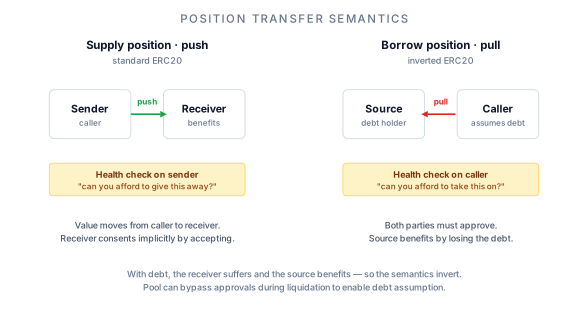
Standard ERC20 transfer semantics push value from the sender to the receiver. The receiver benefits.
For debt, that's backwards — the sender benefits by losing an obligation, and the receiver takes on a liability they didn't have. So XPower Banq inverts the semantics for Borrow Positions:
| Operation | Supply position | Borrow position |
|---|---|---|
transfer(to, amount) | pushes value to to | pulls debt from from (reversed) |
transferFrom(from, to, amount) | standard | requires both parties to approve |
| Health check applies to | the sender | the receiver (who's taking on debt) |
The Pool contract, as a privileged owner, can bypass approvals to enable liquidations — this is what makes debt-assumption liquidation possible.
Transfer with locks
If your position is partially or fully locked, transferring it moves the lock proportionally:
So if you have a 100-token position with 60 tokens locked (60% lock ratio) and transfer 50 tokens, the recipient receives 50 tokens with 30 of them locked. Your remaining 50 tokens still have 30 locked (60% ratio preserved).
This proportional transfer is what makes locked-position secondary markets work: a buyer of locked supply is buying a partially-locked position with the lock fraction intact.
Practical notes
- Standard ERC20 calls work.
balanceOf,totalSupply,transfer,approve,allowanceall behave as expected (with the inverted direction for borrow). Most wallets and indexers will display positions correctly. - Position tokens have decimals. They match the underlying asset's decimals (with a minimum of 6 enforced).
- Position tokens have names and symbols. The
name()is"<token.name()> Supply"or"<token.name()> Borrow"— i.e. the underlying ERC20's fullname()plus the suffix. Thesymbol()encodes side and pair ass<TOKEN>:<BUDDY>for supply andb<TOKEN>:<BUDDY>for borrow. Two special cases apply (seePosition::_symbol): the APOW/XPOW native pair drops the buddy suffix (sAPOW/sXPOW/bAPOW/bXPOW), and WAVAX is rewritten toAVAXon either side. So the APOW supply position in the APOW/XPOW pool has symbolsAPOW(notsAPOW:XPOW), and the XPOW borrow position has symbolbXPOW. In other pairs (e.g. APOW/USDC), the colon form applies:sAPOW:USDC,bUSDC:APOW.
Where to go next
- Transferring positions — the practical mechanics
- Wrapped positions — when to use WPosition
- ERC20 semantics — the developer-facing detail
- Debt-assumption liquidation — what the inversion enables