

How it works
A five-minute tour of the protocol from the user's point of view. We'll defer the math and the contract details to later sections.
The protocol as a building
Think of XPower Banq as a small, automated bank.

There are six contracts inside the building:
- The Vault is the actual safe. Tokens you deposit live here.
- The Pool is the front desk. Every operation — supply, borrow, repay, withdraw, liquidate — goes through it.
- Supply Position and Borrow Position are receipts. They're plain ERC20 tokens that represent what you've supplied or owe.
- The Oracle quotes prices, smoothed over time so a one-block spike can't move them.
- Acma is the door. It controls who's allowed to do what.
- WSupplyPosition (optional) wraps Supply positions as an ERC4626 vault for protocols that expect standard ERC4626 semantics. Borrow positions are not wrappable.
That's the whole system. Everything else is variations on these pieces.
The basic lifecycle
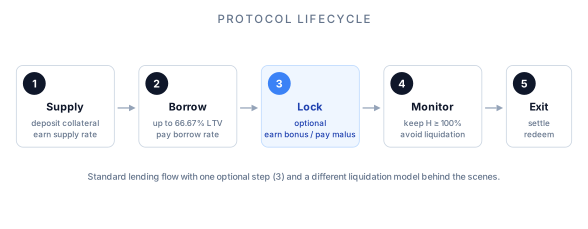
- Supply. You deposit a supported token. You get back a Supply Position ERC20. Your token is now earning interest.
- Borrow. You can borrow a different token against your supply, up to the loan-to-value limit. You get a Borrow Position ERC20 representing your debt. You pay interest on it.
- Lock (optional). You can lock either position for a chosen term — any whole number of quarters from 1 (~3 months) up to 15 (~45 months), or permanently. Locked supply can't be withdrawn; locked borrow can't be repaid early. In exchange, locked suppliers earn extra interest and locked borrowers pay reduced interest.
- Monitor. Your health factor measures how solvent your position is. It must stay above 100%. If the price of your collateral falls or your debt grows, your health factor drops. If it goes below 100%, you can be liquidated.
- Exit. Repay your borrow (called settle) and withdraw your supply (called redeem). You receive your principal plus accrued interest, minus any fees.
The three things people ask about
Why locks?
Lending cascades happen because liquidations dump collateral, and dumped collateral pushes prices lower. If the locked portion of a position can't be sold even after liquidation, that sell pressure simply doesn't exist.

In simulation, the difference is large: under a 25% price shock, locked-only pools see 29.4% of positions liquidated, versus 85.7% in unlocked pools.
The catch: this only works if enough people lock. The protocol incentivises locking with bonus interest, but the equilibrium is path-dependent. See Cascade protection for the full story.
Why "lethargic" governance?
Most protocols can change parameters instantly. That's a security weakness — a compromised governor can drain a protocol in a single block.
XPower Banq governance is deliberately slow: every change is bounded to a 2× factor, and the new value phases in asymptotically rather than jumping.

This means:
- A 2× change takes one cycle (a month).
- A 10× change takes 4 cycles.
- A 64× change takes 6 cycles.
You always have time to react.
Why does liquidation work this way?
Most protocols require the liquidator to repay the victim's debt with their own liquid capital, in exchange for discounted collateral. That's restrictive — liquidation gets dominated by a few well-capitalised firms.
XPower Banq liquidation is debt assumption: the liquidator takes on a slice (typically half) of the victim's debt and the corresponding collateral, atomically. They need their own collateral to absorb the new debt — but no liquid stablecoins.

The economics are equivalent to a traditional liquidation, but the capital requirements are very different. A user with 1.5 APOW of collateral can liquidate a position worth 1 APOW; in a traditional protocol, they'd need 1 APOW of stablecoins instead.
The pieces you don't have to think about
These run automatically and you can mostly ignore them:
- Interest rates rise as utilization rises, with a sharp slope above the kink at 90% utilization. This pushes utilization back down toward the optimal level.
- The oracle updates at most once per hour, smoothing prices over a 12-hour half-life. Sudden price moves take time to propagate.
- Position caps rate-limit how fast any one address can grow. New users get a baseline allocation; the cap shrinks as you approach a 1/3 share of the pool.
- Governance parameter changes always pass through the lethargic transition.
Where to go next
- Concepts in detail: Lending basics and Health factor
- Each feature in depth: start with Locked positions
- Use it now: Quickstart