

Timed vs permanent locks
XPower Banq supports two flavours of position lock. They look similar from the outside but behave differently in important ways.
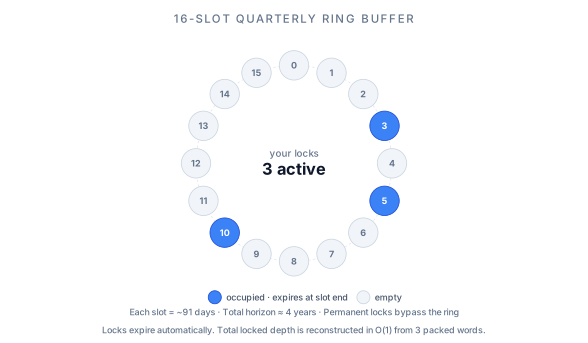
Timed locks
A timed lock pins your principal for a specified duration, then expires automatically. The protocol stores up to 16 active timed locks per user, each in a quarterly slot. Each slot represents one calendar quarter (~91 days).
- Minimum term: any positive seconds offset; in practice locks land in the next slot at minimum (~3 months remaining of the current quarter).
- Maximum term: 15 slot-offsets from
now, ≈ 45 months. The ring buffer's total horizon spans 16 slots ≈ 48 months, but the slot already holding the next-expiring lock can't be re-targeted — only the next 15 slots are addressable fromnow. - Granularity: quarterly. A lock created at any time during a quarter expires at the end of that quarter (after the chosen number of slots).
- Expiry: automatic. No action required from you. Once a slot's epoch has passed, the locked tokens become liquid again.
You can have multiple timed locks at once — different amounts with different expiry dates. The 16-slot ring buffer means you can structure a "ladder" of locks expiring at staggered intervals.
Slot semantics
The ring buffer reuses slots after ~4 years. If you create a new lock that maps to a slot containing an already-expired lock, the protocol cleans up the old one automatically (a "self-healing" operation). You don't need to manually clear expired locks, but doing so via the Position's free(user) operation reclaims gas in subsequent operations.
Permanent locks
A permanent lock has no expiry. The principal is locked forever. You created it; you can never redeem it.
- Term: infinite.
- Storage: the protocol uses a single packed field for permanent locks rather than ring slots, so adding to a permanent lock is cheaper than adding to a timed lock.
- Cascade attenuation: the (1 − ϕ) attenuation in the cascade theorem applies only to the permanent-locked fraction. Timed locks contribute attenuation only until their expiry.
When to use which
| Situation | Recommendation |
|---|---|
| You have a known holding period (e.g., locked employer tokens, a tax planning horizon) | Timed lock matched to your horizon |
| You want maximum bonus and don't care about flexibility | Permanent lock |
| You're a long-term APOW holder using XPower Banq as yield infrastructure | Probably a permanent lock or a multi-year timed lock |
| You're using XPower Banq tactically (leverage, arb) | Don't lock — keep your liquidity |
| You want some lock for the bonus, some for flexibility | Lock part of your position; leave the rest liquid |
Bonus differences
The interest bonus/malus scales with your lock ratio — the fraction of your balance that's locked, weighted by remaining time. Permanent locks count at their full value forever; timed locks contribute proportionally to their remaining duration.
This means a permanent lock of 1 token earns more bonus than a 1-quarter timed lock of 1 token, integrated over time. See Bonus and malus for the formula.
Cascade-protection asymmetry
The Cascade Attenuation Theorem (in the protocol whitepaper) bounds cascade severity by (1 − ϕ), where ϕ is the permanent-locked fraction.
Timed locks attenuate cascades only while active. A timed lock that expires the day before a crash provides zero protection. Permanent locks always count.
If your goal is cascade protection — e.g., you're a major supplier who wants the pool to survive — a permanent lock is the only way to commit credibly.
Practical advice
- Most users supplying for yield should pick a timed lock with a multi-quarter horizon. The bonus is meaningful and the commitment is bounded.
- Borrowers should be conservative with locks. Locking your debt prevents early repayment, which can hurt if your circumstances change.
- Permanent locks are an ideological choice as much as a financial one. Don't make it lightly.
Where to go next
- Bonus and malus — the rate adjustments
- Transfers and exits — how to get out of a lock
- Locking positions — the practical UI/call walkthrough